Rio de Janeiro, Brazil · UTC−3 · Remote or relocation
Renan Sued
Senior AI Engineer · Solution Architect
I build production software: enterprise platforms, AI agents, and the engineering teams that run them.
I've shipped software since 2014, from mobile apps to Java and AWS enterprise platforms. Today I lead teams whose platforms reach 93.4M+ six-month active users. Since 2020 I've built LLM agents with guardrails, retrieval and human review, at work and in BikerWay, my own product.
whoami
Renan Sued
Senior AI Engineer · Solution Architect
Rio de Janeiro, Brazil · UTC−3
open to remote or relocation
Engineering impact
Scale I've worked at, not adjectives.
shipping software since
2014
About 12 years, from mobile apps to enterprise platforms.
six-month active users
93.4M+
Users active within a six-month window on the enterprise platforms delivered by the teams I lead.
teams · engineers led
5 · 15
Cross-functional teams at Lumis, plus mentoring engineers and architects.
of daily transactions
Millions
Through the APIs, event-driven services and DXPs I architected.
AI systems delivered at Lumis
4
SDLC agents, process-automation agents, a RAG assistant, a content agent.
hands-on with LLMs since
2020
Claude, OpenAI, Gemini and DeepSeek models.
What I build
Six kinds of systems, one way of working.
AI Systems
Agents and LLM applications built for real workloads: SDLC automation, process-automation agents with prompt-injection protection and a retrieval-backed assistant (both in production), and content agents with human review.
GuardrailsRAGHuman-in-the-loopMCPDistributed Systems
Event-driven services and high-availability platforms for regulated financial clients, and event queuing with guaranteed execution and no duplicate processing.
Event-drivenHigh availabilityKafkaPythonBackend Platforms
Java APIs and Digital Experience Platforms taken from design to deployment, processing millions of daily transactions with security and compliance built in.
JavaSpring BootREST APIsDXPCloud Infrastructure
Cloud-native architecture on AWS with infrastructure as code, containers and least-privilege access. Managed Postgres, edge functions and serverless when they fit the constraint better.
AWSIaCDockerSupabaseDeveloper Platforms
The machinery that lets teams ship: DevSecOps and LLMOps, CI/CD, quality gates, OpenTelemetry, and agents that take a task from pickup to staging.
CI/CDSonarQubeOpenTelemetryClaude CodeProduct Engineering
End-to-end products: BikerWay across mobile, web, admin and data; A/B and multivariate experimentation for marketing platforms; fintech products at Sued Team, which I founded.
MobileWebExperimentation0 → 1
AI in production
The model is one box. The system is the job.
- Production
- Runs against real users or production data
- In use
- Internal tooling I actively use
- Experimental
- Built and tested, not operated regularly yet
- Planned
- Designed and on the board, not built
A six-step pipeline. Select a step to see what it means and where I have built it.
01 · intent & approval
Human
Sets the goal and owns the risk. Anything irreversible, paid or public waits for an explicit yes.
Where I've done this
Content agent with human-in-the-loop review
ProductionConfidence scoring decides which items a person reviews before publishing.
Approval gate before any paid pipeline run
ProductionBikerWay data pipelines stop and ask on Telegram before paid or slow work.
Human-only risk gates for the agent team
In useMerge to main, production migrations, first paid API call and public publishing always stop for me.
The concepts, grounded
Agent orchestration
One coordinator, many narrow specialists, explicit rules for who decides when they disagree.
Lumis AI-first delivery · BikerWay agent team
Tool calling & MCP
Agents act through tools with scoped credentials, not through free-form access.
Lumis tooling · BikerWay pipelines
Structured outputs
Model output is data with a schema. If it doesn't parse, it doesn't ship.
BikerWay data platform
RAG
Chunking, embeddings and vector search behind an assistant used by a law firm's clients.
Lumis · multinational law firm
Automated workflows
Agents that move a task from pickup to staging, or content from search to publish.
Lumis SDLC agents · content agent
Human-in-the-loop
Confidence decides what a person must review; humans approve anything paid, public or irreversible.
Lumis content agent · BikerWay approval gates
Observability
Traces, run histories and cost per call, so an agent's behaviour can be explained after the fact.
OpenTelemetry at Lumis · BikerWay pipeline runs
Evaluation & quality gates
Scores computed from objective signals, with thresholds per domain that decide auto-approve or review.
BikerWay ingestion layer · Lumis content agent
Guardrails
Input/output validation and prompt-injection protection. Third-party content is data, never instructions.
Lumis production agents
Production reliability
CI/CD, least privilege, budgets that fail closed and approval gates in front of paid or risky steps.
Lumis LLMOps · BikerWay runtime
Case study · BikerWay
My own product, built like a production system.
The problem
Riders in Brazil plan trips around questions generic map apps don't answer well: which fuel stations, workshops and places to stay can be trusted, and which roads are worth riding on a motorcycle. Clubs and group rides run on scattered chat groups. No single product brought the map and the community together.
The goal is something like PlugShare for motorcyclists: a shared map that the community confirms, corrects and extends, where a new rider sees useful routes and places on the first day.
The product
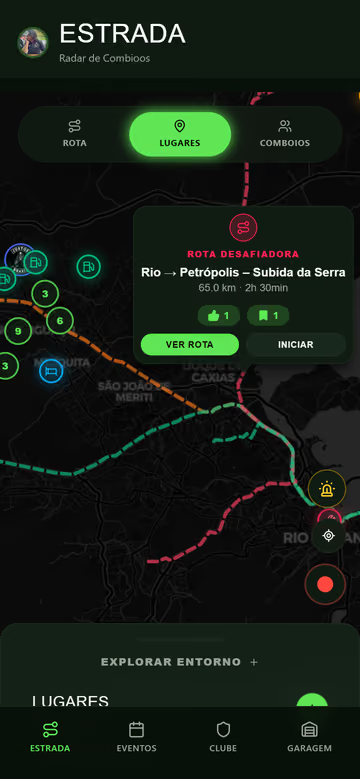
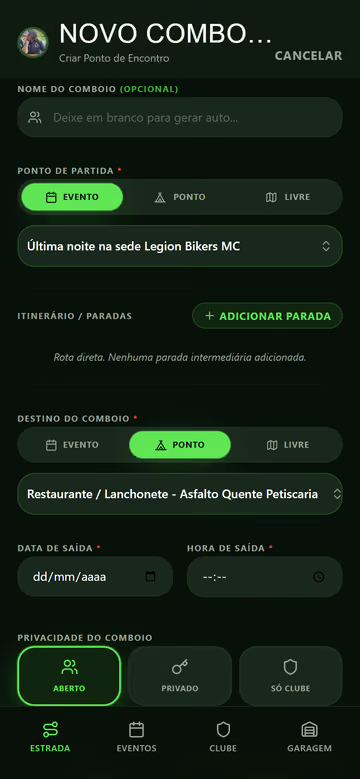
Live convoys
Group rides on a live map. A native background-location task keeps the convoy visible while phones sit in pockets.
Routes & trusted places
Recommended routes, rider-relevant places (fuel, workshops, viewpoints), reviews and a community consensus on fuel prices.
Clubs
Motorcycle clubs with rankings, territories, recruitment and check-ins.
Events & invites
Events and club meetups, shareable invite links that open the app or fall back to a download page.
Garage
A virtual garage with fuel consumption, expenses and maintenance history per motorcycle.
Ride journal
A log of past rides with distance, duration, number of motorcycles and photos.
AI inside it, with honest status
- Route & place discovery pipelinesProduction
- Single ingestion layerProduction
- Agent development teamIn use
- AI marketing engineExperimental
- AI runtime with cost controlExperimental
- Content agent team (AG-0…AG-7)Planned
AI workforce · my working thesis
Agents as an engineering organization, with a human holding the keys.
The BikerWay agent team, from the human founder down to specialists. Select an agent to see its role.
Human
Orchestration
tech-lead
In useOrchestration
Reads the story, picks the relevant specialists, merges their positions into one plan and keeps architecture docs and the board honest.
Synthesizes when positions converge.
Arbitration
Product
Build
Quality & risk
tech-lead
In useOrchestration
Reads the story, picks the relevant specialists, merges their positions into one plan and keeps architecture docs and the board honest.
Synthesizes when positions converge.
What this is, honestly
This is not an autonomous company. The agents don't talk to each other in the background and nothing runs on a schedule yet. A session I open invokes each specialist, collects their written positions and applies the arbitration rules. The value is in the constraints: who may decide what, what needs a human, and what gets written down.
How a story becomes code
- 1
Story. I write or update the story on the board.
- 2
Triage. The tech lead decides which specialists matter for it.
- 3
Consult. Each specialist returns a short written position: approach, risks, cost.
- 4
Converge or arbitrate. Agreement → one plan. Technical split → CTO. Business split → CEO. Vulnerability → security veto.
- 5
Implement. Build agents execute the single plan.
- 6
Verify. QA runs the suites and lists what still needs a real device.
- 7
Review. Security (blocking) and legal review anything touching auth, personal data or payments.
- 8
Close. The board is updated to match reality, not intentions.
Risk gates that always stop for a human
- Merge to main / production deploy
- Applying a schema or RLS migration in production
- The first paid API call in a session, and any large batch
- Publishing anything publicly
- Using a personal token or rotating credentials
- Switching LLM provider in the middle of a story
The design problem, dimension by dimension
- Production
- Runs against real users or production data
- In use
- Internal tooling I actively use
- Experimental
- Built and tested, not operated regularly yet
Responsibilities
In useOne role per agent, written down as a versioned definition, with explicit decision rights.
Tools
In useEach role's definition scopes it to its own repositories. Next: content agents that act only through an MCP server over one ingestion layer.
Permissions
ProductionThe database checks permissions, not the prompt. A scoped service account per pipeline today; one per content agent is planned.
Memory
In useA shared context repo (architecture, schema checklist, roadmap, real status log) is loaded into every session in every repo.
Workflows
In useThe consensus protocol for building; discover → enrich → score → ingest for data.
Evaluation
ProductionConfidence scored from evidence. Next: per-agent approval rate and cost per approved item in the curation queue.
Human approval
In useRisk gates for anything irreversible, paid or public; an approval message before every paid pipeline run.
Observability
ProductionRun and step history for every pipeline; token cost recorded per call.
Failure handling
ExperimentalIdempotent resume by status, budgets that fail closed, and a planned per-agent off switch.
Next layer: content agents in the production data path
PlannedA team of agents that keeps BikerWay's catalogue alive. Each will have its own database identity and permissions, write only through the shared ingestion layer, and send anything below its confidence threshold to a human curation queue.
- AG-0 Editor-in-chief
- AG-1 Places
- AG-2 Events
- AG-3 Famous routes
- AG-3B Composed routes
- AG-4 Challenges & badges
- AG-5 Parts & manuals
- AG-6 Offers
- AG-7 Verifier
Experience
From shipping apps to leading platform teams.
Dec 2021 – present · Rio de Janeiro
Solution Architect | Software AI-Systems Engineer · Lumis
Technical lead for five teams building enterprise platforms, and the engineer behind the AI systems around them.
Impact
- Lead 5 engineering teams (15 engineers) delivering enterprise platforms for 93.4M+ six-month active users; mentor engineers and architects; chapter leader for practices and tooling.
- Architected scalable APIs, event-driven services and multiple Digital Experience Platforms from design to deployment, processing millions of daily transactions.
- Led engineering and architecture for critical banking and insurance clients: security, compliance and high availability for regulated workloads.
- Designed developer agents that automate the team's SDLC end to end, from task pickup through implementation and testing to staging handoff.
- Built and operate production AI agents for process analysis and solutioning, with LLM guardrails, input/output validation and prompt-injection protection.
- Led a WordPress → Java/Lumis XP migration for a multinational law firm, including a production AI assistant built on vector databases, embeddings and chunking.
- Delivered an autonomous content agent (search, generate, analyze, publish) with confidence scoring and human-in-the-loop review.
- Established DevSecOps and LLMOps practice: CI/CD, infrastructure as code, Docker, SonarQube, OpenTelemetry and least-privilege access.
Key engineering challenges
- Making AI trustworthy enough for production: validation, guardrails and human review designed in from the start.
- Security, compliance and availability requirements of regulated financial clients.
- Bringing AI-first tooling to five teams without fragmenting how they work.
Technologies
JavaAWSCloud-nativeAgent orchestrationMCPVector databasesDockerIaCSonarQubeOpenTelemetryClaude CodeCursorLumis XPJan 2017 – Dec 2021 · Rio de Janeiro
Software Development Engineer · Lumis
Full-stack engineer who grew into technical leadership of a major retail web platform and of the team's DevOps modernization.
Impact
- Technical leader for the web platform of a major Brazilian shopping-mall group: corporate applications on content experimentation platforms with Java, React, Vue.js, AWS and SQL.
- Technical leader for DevOps modernization (Git, Jenkins, Docker, SonarQube) and event-driven architecture; automated A/B, auto-targeting and multivariate testing for marketing experiments.
- Event queuing and file processing with Python and Kafka, with guaranteed execution and no duplicate processing.
- Full-stack development across Java, JavaScript, Node, React, Redux, Lumis XP, jQuery and XSL.
Key engineering challenges
- Introducing CI, containers and code-quality gates into a delivery process that was already running.
- Automating marketing experiments: A/B, auto-targeting and multivariate tests.
Technologies
JavaJavaScriptReactVue.jsNodePythonKafkaAWSSQLJenkinsDockerSonarQubeJun 2015 – Dec 2016 · Rio de Janeiro
Software Engineer · Founder · Sued Team
Founded the team and led engineering for enterprise fintech applications.
Impact
- Built end-to-end fintech products with Java, Android, MVC, MySQL, Node and React.
- Managed 4 projects across military, pet-tech and political-research domains.
Key engineering challenges
- Owning a product from first line of code to client delivery.
Technologies
JavaAndroidMySQLNodeReactJan 2015 – Dec 2016 · Rio de Janeiro
Software Engineer Mobile · Fluxo Consultoria UFRJ
Mobile apps with security and recognition requirements.
Impact
- Military fitness-assessment app for FAB (Brazilian Air Force): Android, Firebase, JWT, OAuth2 and custom cryptography.
- Automated medicine recognition from prescriptions with OCR (Tesseract).
Key engineering challenges
- Security requirements of a military client on a mobile platform.
Technologies
AndroidFirebaseJWTOAuth2Tesseract OCRJun 2014 – Dec 2016 · Rio de Janeiro
Software Engineer Fullstack · Sued Team
Where it started: apps for students and teachers.
Impact
- Mobile and web apps for students and teachers at two federal public education institutions (MySQL, PHP, GCM push, Android, Linux VPS).
Key engineering challenges
- Shipping and hosting real apps for real schools while still studying.
Technologies
AndroidPHPMySQLGCMLinux
Education & credentials
B.Eng. Control & Automation Engineering, PUC-Rio · 2024
Additional domain in Software Engineering. Thesis: GADEMO Web, simulation and evolutionary optimization with genetic algorithms.
Technical Diploma, Control, Robots & Automation, CEFET/RJ
Secondary-level technical program.
Google Generative AI Leader · Google Cloud · 2026
Certification in strategic and applied generative AI.
Claude Certified Architect · Anthropic · in progress
Not obtained yet.
2nd place, PUC-Rio Sustainability & Energy Hackathon · 2018
Selected engineering work
Problems, decisions and results.
- Beta
My product · founder & lead engineer
BikerWay
Riders lack a trustworthy, rider-specific map of routes and places, and the tools for group rides and clubs are scattered.
Approach, architecture, result & lessons
- Approach
- A native app on a shared Supabase backend, a data platform where AI proposes catalogue entries under rules and human approval, and a team of Claude Code agents that refines and builds the roadmap.
- Architecture
- Five repositories, one Supabase project, one ingestion layer, approval gates in front of paid and irreversible work.
- Technology
- Expo / React NativeTypeScriptSupabaseNext.jsViteZodn8nGemini · OpenAI · DeepSeekClaude Code
- Result
- Android app in beta with real testers; web app and admin panel in production; AI pipelines writing evidence-backed data to production.
- What I learned
- The hardest cross-repo bugs came from missing shared context, not from having many repos. Context is infrastructure.
Lumis · 2021 – present
AI systems at Lumis
Delivery teams and enterprise clients needed AI that holds up in production, with validation, guardrails and human review.
SDLC developer agents
In use- Problem
- Manual hand-offs between picking up a task and handing it to staging.
- Approach
- Autonomous developer agents covering implementation and tests up to the staging/homologation handoff.
- Result
- Manual steps removed from the release path; releases accelerated.
Process-automation agents
Production- Problem
- Process analysis and solutioning done by hand.
- Approach
- Production agents with agent training, LLM guardrails, input/output validation and prompt-injection protection.
- Result
- In production, built and operated by me.
Assistant for a multinational law firm
Production- Problem
- A WordPress platform that had to scale, and a client-facing assistant on top of it.
- Approach
- Migration to Java / Lumis XP at scale; retrieval with vector databases, embeddings and chunking.
- Result
- Production AI assistant for client-facing use cases.
Autonomous content agent
- Problem
- Registering content on emerging platforms.
- Approach
- Search → generate → analyze → publish, with confidence scoring deciding when a human reviews.
- Result
- Delivered with human-in-the-loop review.
Technology, result & lessons
- Technology
- AI agentsAgent orchestrationMCPVector databasesEmbeddingsLLM guardrailsJavaAWS
- Result
- Four AI systems delivered; two of them run in production.
- What I learned
- In production AI, the validation and review paths take more design work than the prompt.
- Production
Lumis · banking and insurance clients
Regulated platforms & DXPs
Critical banking and insurance clients need platforms that are secure, compliant and always available.
Approach, architecture, result & lessons
- Approach
- Scalable APIs, event-driven services and Digital Experience Platforms, designed and taken to deployment, with DevSecOps practices and least-privilege access.
- Architecture
- Cloud-native services on AWS; event-driven integration; CI/CD with quality and security gates.
- Technology
- JavaAWSEvent-driven architectureDockerSonarQubeIaCOpenTelemetry
- Result
- Millions of daily transactions with high availability, performance and security for regulated workloads.
- What I learned
- In regulated systems, compliance is an architecture input, not a review step at the end.
Open source · Java
Distributed rate limiter
Enforce a global rate limit across a fleet of servers without a network call on every request.
Approach, architecture, result & lessons
- Approach
- Sharded counters per key on a distributed key-value store, local batching flushed on an interval, and non-blocking decisions from the last known global count plus pending local deltas.
- Architecture
- Store abstraction, retry policy and circuit breaker for store failures, pluggable metric publishers (Prometheus, CloudWatch).
- Technology
- JavaCompletableFuturePrometheusAWS CloudWatchMaven
- Result
- Public repository with a builder API, a mock store for tests and documented operational trade-offs.
- What I learned
- Choosing eventual consistency for latency is a product decision. The error bound should be explicit and observable.
FAB (Brazilian Air Force) · via Fluxo Consultoria UFRJ
Military fitness-assessment app
A mobile fitness-assessment app for the Brazilian Air Force.
Approach, architecture, result & lessons
- Approach
- Native Android app with Firebase, token-based auth (JWT, OAuth2) and custom cryptography.
- Technology
- AndroidFirebaseJWTOAuth2Cryptography
- Result
- Delivered mobile app for the Brazilian Air Force.
- What I learned
- Security requirements shape the data model from day one, not the release checklist.
B.Eng. thesis · PUC-Rio · 2024
GADEMO Web
Simulation and evolutionary optimization with genetic algorithms, one of the foundations of machine learning.
Approach, architecture, result & lessons
- Approach
- A computational approach to simulating genetic algorithms and evolutionary optimization, presented as my engineering thesis.
- Technology
- Genetic algorithmsEvolutionary optimizationSimulation
- Result
- Bachelor of Engineering thesis, PUC-Rio.
- What I learned
- Optimization is search under constraints, the same framing I now use for agent workflows.
Engineering stack
Depth over logos.
Languages
Java for a decade of enterprise work, TypeScript for everything BikerWay.
- Java
- TypeScript
- Python
- JavaScript
- SQL
- Kotlin
- Go
Backend
APIs and platforms built to sit behind products other people depend on.
- REST APIs
- Node.js
- Lumis XP (DXP)
- Edge Functions
- Spring Boot
- Hibernate / JPA
AI
Agents and LLM apps with the parts that make them safe to run.
- AI agents
- Agent orchestration
- MCP
- RAG · embeddings · chunking
- Guardrails
- Prompt-injection defense
- Human-in-the-loop
- Structured outputs (Zod)
- LLMOps
- Claude Code · Cursor
- Claude · OpenAI · Gemini · DeepSeek
- pgvector · Pinecone · Chroma
- LangChain
Cloud
AWS for enterprise; managed Postgres and edge platforms when the budget is the constraint.
- AWS
- Supabase
- Vercel
- Firebase
- Serverless / Lambda
- Azure
- Cloudflare
Infrastructure
Pipelines that make the safe path the default path.
- Docker
- Infrastructure as Code
- CI/CD
- Jenkins
- SonarQube
- DevSecOps
- Kubernetes
- Terraform
- GitLab CI
Data
Events, relational data and the provenance that keeps them trustworthy.
- Kafka
- Postgres + RLS
- MySQL
- Vector databases
- OpenStreetMap · Google Places
- Elasticsearch
- NoSQL
Observability
If an agent did something, I want to be able to explain why.
- OpenTelemetry
- PostHog
- Sentry
- Pipeline run tracing
- Prometheus
- Grafana
- Datadog
Architecture
Patterns chosen for the constraint, not for the résumé.
- Event-driven architecture
- Cloud-native
- High availability
- Digital Experience Platforms
- Experimentation (A/B, multivariate)
- Microservices
- Distributed systems
How I think
Principles I build by.
- 01
Build systems, not demos.
A demo answers "can it work?". A system also answers "what happens when it doesn't?". Guardrails, validation, observability and rollback come with the feature, not after it.
from: Production agents at Lumis
- 02
AI is an engineering problem, not only a prompt.
Schemas, retrieval, evaluation, permissions and cost all matter more than the wording of a prompt once real users depend on the output.
from: RAG assistant · BikerWay data platform
- 03
AI proposes, rules decide, humans curate.
The model suggests. A deterministic score built from evidence decides what is safe to publish, and a person reviews the rest. The model never approves its own work.
from: BikerWay agent design
- 04
Third-party content is data, not instructions.
Anything an agent reads from the outside world may be hostile. Prompt-injection protection belongs in the architecture, enforced where the prompt can't override it.
from: Guardrails at Lumis · BikerWay ingestion
- 05
Architecture exists to solve constraints.
Regulated finance made availability and compliance the inputs. A fixed monthly budget made free tiers and fail-closed AI spending the inputs. Same discipline, different constraints.
from: Banking & insurance platforms · BikerWay
- 06
Automation needs provenance and an off switch.
Every automated write should say who wrote it, from what evidence, and be stoppable without a deploy. That is what makes automation something a team can actually trust.
from: BikerWay ingestion layer
Off the clock
I like building things that move.
Motorcycles
Riding, and building BikerWay for other riders.
Railways
Large, scheduled, safety-critical systems moving in real time.
Electronics & IoT
Sensors, microcontrollers, and the line between hardware and code.
Travel
New places, new constraints, and a reason to plan routes.
Contact
Have a hard engineering problem?Let's talk.
Rio de Janeiro, Brazil · UTC−3 · Remote or relocation. Open to AI Engineer, Applied AI, Forward Deployed, AI Platform and Staff / Senior Backend roles.